Thursday, April 02, 2015

Towards Easter Sunday, April 5, 2015

Scripture:  Mark 16:1-8
Sermon:  Risen Jesus - a step ahead of us

Why don’t we go Easter carolling this year? 


OK … I know we don’t even do Christmas carolling anymore.  But still, why don’t we go Easter carolling?   

At Christmas, we’re happy to let all the world know that in a child born in Bethlehem, God has come to dwell among us – that in Jesus we are given the gift of seeing how life is to be lived, and what kind of world Earth is meant to be.   

          Joy to the world!  The Lord is come:
          let earth receive her king!
          Let every heart prepare him room,
          and heaven and nature sing. 

So why at Easter do we not take to the streets with songs that this One – the One who heals the sick, lifts up the poor, forgives the sinful, welcomes the rejected, challenges the powerful, and overturns injustice, is alive and still kicking? 

Why is it we don’t go out some night this week or next – or maybe Easter morning, to sing songs that the One who shows us real-human-living and Earth-set-right, is still here … is not dead and gone … is not defeated by powers of evil, ignorance and greed … is still alive, present and at work in the world in more ways and places than any can imagine? 

How about this for a starter? 

          Joy to the world!  The Lord’s still here:
          Let earth embrace her king!
          Let every heart rise up and cheer, 
          and heaven and nature sing.

          No more let sins and sorrows grow,
          nor greed pollute the ground;
          he's raised to make God's blessings flow
          far as the curse is found.

          He loves the Earth with truth and grace,
          and makes the nations prove
          the glories of God's righteousness
          and wonders of God's love.
        
Easter caroling, anyone?


Thursday, March 26, 2015

Towards Palm Sunday, March 29, 2015

Scripture:  Mark 11:1-11

Jesus' entry into Jerusalem was a big deal, and even he seems to have given a fair bit of thought to it.  Verses 1-6 make it pretty clear that Jesus and a few of his followers planned the event pretty carefully to make the maximum prophetic challenge to the powers of the day, and the maximum public splash.  I also wonder if the crowd's response in verses 8-10 was purely spontaneous, or was sparked at least a bit by a few people prepared ahead of time to act out the prophetic acclamation of God's king.  If so, they seem to have been pretty successful in pulling off the event they wanted.

But then after all it all comes off so well, we read:

       then he entered Jerusalem and went into the temple; and when he had
       looked around at everything, as it was already late, he went out to Bethany
       with the twelve.

What?!?  Sure, it was late and the end of a very big day.  But they just looked around and then left?

The fact that Jesus climaxed (or anti-climaxed) his big day by just looking around, seeing it was late, and going back with his followers to a friend's house just outside the city -- and that he went back there with them every other evening in the momentous week that followed, reminds me that we often over-estimate Jesus' desire to be in charge of everything -- both then and now.

Maybe enough for him, that he make the great splash to wake us up, spend time getting us oriented in the kingdom direction, and then step back and let us do our (or God's) thing.

If that is his way -- both then and forever, I wonder if it changes anything in the way we think about, believe in, or act out our faith?

Monday, March 23, 2015

Sermon from Sunday, March 22, 2015

Scripture:  Jeremiah 31-31-34 and John 12:20-36
Sermon:  The heart of the world

A number of years ago when I was on week-long retreat at the Ignatian Centre in Guelph I was especially struck and touched by a particular religious statue on the grounds.
 
 
Whenever I am there I like to walk the grounds and make use of the space.  There are paths through the woods, across fields, and alongside and over a stream.  There are two labyrinths – one traditional, modelled after the one in the cathedral of Chartres, and the other a kind of huge evolutionary spiral celebrating the unfolding of the cosmos with different stations of life’s emergence along the way.  There’s the chapel with stained glass and different images and icons, as well as nooks and crannies around the building with a variety of images and candles and icons to speak to different people at different stages of their spiritual journey, to help them connect and re-connect with God and with their deepest self. 

Every time I come back I wish I could take you there, for you to see and experience the place as well.  And maybe we’ll do that sometime – enjoy a spiritual field trip. 

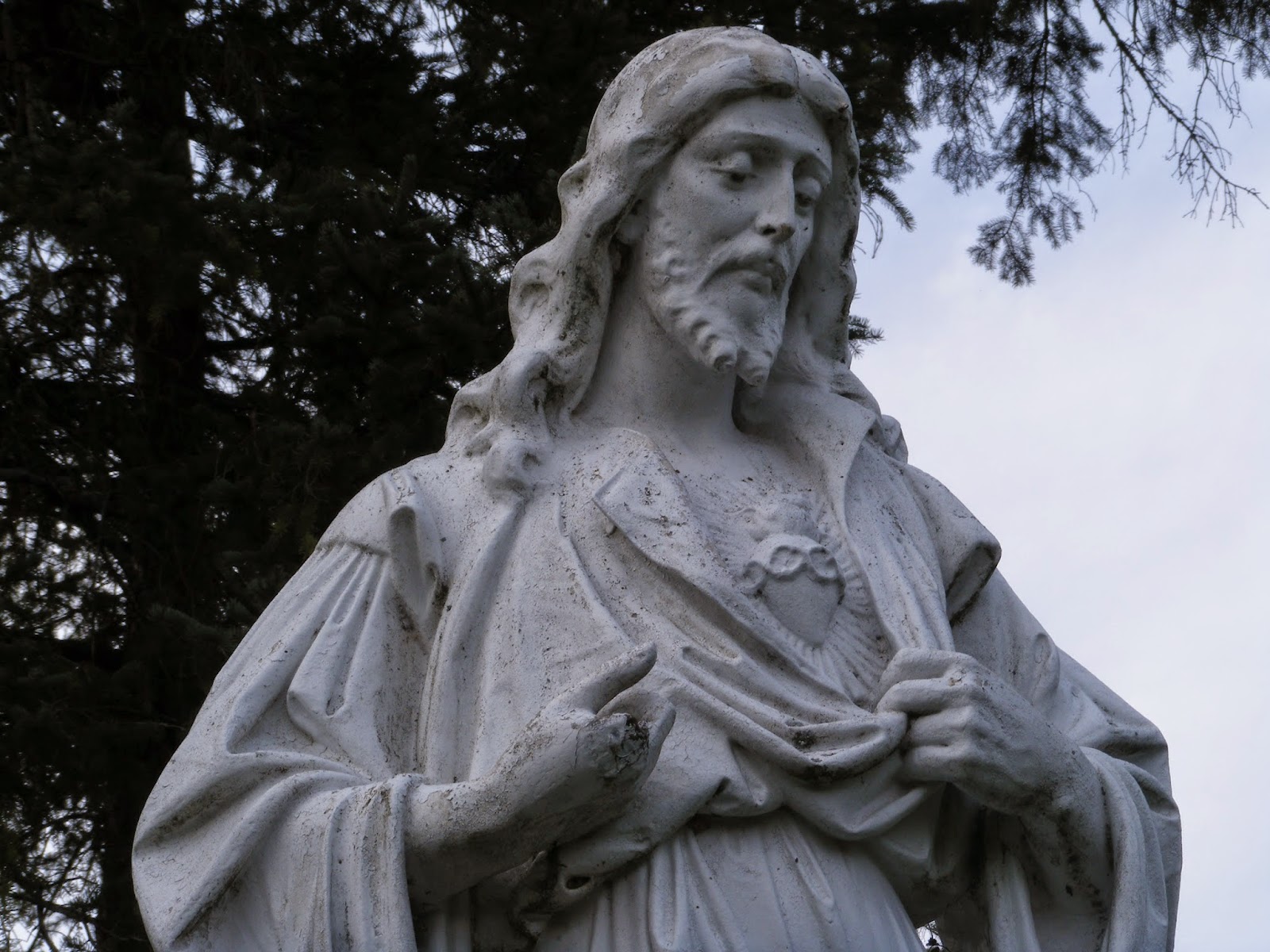
A few years ago one statue In particular caught my attention and stirred something in me.  It’s the statue that shows what Roman Catholics know as the blessed heart of Jesus – a statue of Jesus with his chest opened and the strong, compassionate heart of God burning and beating within him.   

The statue stands across the road from the main building and overlooks a small plot of land bounded by a hedge, in which are laid to rest the remains of Jesuit brothers who have died and been buried there over the years.  I had seen it before and hadn’t thought much of it.  Protestants generally don’t focus on the blessed heart of Jesus.  We even tell jokes about it.  I used to call it the statue of “the Jesus of open-heart surgery.” 

This time, though, it must have been me that needed opening-of-the-heart surgery because it touched me deeply.  And for some months after coming back home and to work here, when I would be talking with someone about a struggle they or someone they knew was having, I would suddenly and pleasantly get an almost sensory experience of the heart of God beating within my own chest – shaping, informing and enlarging within me a deep and very particular kind of compassion for the other, and I would recall this image of Jesus, and give thanks that I could share in God’s life in this way – could feel the heart of God beating within my own body, my life a vessel of God’s compassion – big enough, or maybe small enough, to be of use. 

This morning we have read Jeremiah’s vision and promise of God writing the divine law of love on all our hearts. 

Jeremiah lived in a time when the people are doing all they know how to be good and better than they have been.  They know they have made a mess of things.  As a kingdom they have wandered far from the good way of being God has shown them, and as a people they are far from being holy, just, compassionate, and a light to other nations. 

So when they find the old law books – the Torah of Moses and the laws about how to be a good kingdom together, they dust them off, confess their waywardness and promise to follow the old ways again.  They clean up and renovate the Temple, which had become quite a mess.  They reform the priesthood and commit themselves anew to the system of worship, offerings and prayers that had been their ancestors’ spiritual practice.  The king himself – good, religious king Josiah, spearheads the reform and the movement back to the basics. 

But it doesn’t work, and Jeremiah sees it.  He doesn’t like what he sees.  Even more he hates being the one to blow the whistle on how it isn’t working, and how the top-down, back-to-the-good-old days reform is actually only making things worse.   

The people also hate Jeremiah for it.  They don’t like being told the truth about the way they are headed when they are only doing the best they knew how. 

But Jeremiah sees what we also know from experience: 

·       that the powers of the day never get it right all the time – that even though they may be well-intentioned and well-informed and even pious, and sometimes do and enact exactly the good and right thing, as leaders (especially the higher up they are) they are also so bound to their own need for power, the need to serve the interests of others in power who support them, and at times simply so caught by their own human blindness and pride, that inevitably they offer a mixture of both bad and good leadership and laws 

·         that even when good laws are passed and good directions of compassion, care and love for what God loves are set by the king and the government, effective education and enforcement is always another question; people and powers with other agendas always find a way around them 

·         that even when victories are won, barriers are broken, and good gains are made towards equality, justice, understanding, compassion, openness and inclusiveness of care, they always have to be won over and over again, anew in each generation, because there is something unholy as well at work within us – especially when we gather in groups and tribes, that resists and undoes the good of all for the sake of self-interest 

The people – especially the king, hate Jeremiah for bringing all this to their attention.  They abuse him.  They arrest him.  They deport and exile him.  He seems to be the bearer of nothing but bad news, so they label him treasonous – an under-miner of public confidence and the security of the state. 

Which makes the reading today all the more remarkable, because it’s a moving and inspiring piece of good news from Jeremiahg – a vision of a truly better day coming, that stands in stark contrast to the current reality, and the hopefulness of which is really seen only when set against a clear understanding of the current darkness. 

“A day is coming,” Jeremiah says, “when the law of God – the law of loving together what God has made, will be written not on stone, but on the human heart – not as laws that are a mixture of good and bad, that we cannot completely enforce, and that have to be rewritten every generation because we always find ways to undo their intent – but as a basic knowledge of what is good and right, of what is loving and just, written on all our hearts and simply, spontaneously beating in tune with God’s perfect desire in all our living and all our being together.” 

Can you imagine such a day?  Jeremiah could. 

Can you imagine such a life?  We believe we have seen one.  What makes us Christian is our shared belief that in Jesus such a promise and such a life has come to be – that in Jesus the heart of God truly has come to dwell and to beat in human being and living. 

And so what about us?   

We are called to share in this life – for our own sake, for our own wholeness, and for the sake of the world and its goodness, because it really is the only way that the heart of God beats steadily in our world – if people like us of faith, hope and love, are able to let God’s heart beat in and through us.
 
We know we can live that way.  Our hearts can be opened to God and beat in tune with God’s heart, but I think we also know it’s never a once-for-all-time operation and transformation.  It’s something we have to renew and struggle towards and let ourselves be opened to time and again, in different ways, depending on where we are in our journey.

Sometimes and in some situations – in response to some needs, it’s easy to know the response of God’s heart, and to act it out. 

Other times, though, and in other situations and issues, we wonder.  Things get complicated.  There are different sides to an issue that others may see, that God definitely sees, that are good for us talk about, and slowly to feel our way together towards the desire of God – or at least what it may be. 

And other times yet?  There are so many times when our own self-interest is strong, when cultural attitudes are engrained, when pride and blindness and habit get in the way – times when we really do need a little opening-of-the-heart surgery. 

And a good question is: how do we do that?  How do we open ourselves to it?  How do we share together in that spiritual process – that spiritual journey of dying and rising together with Christ to new life?

Tuesday, March 17, 2015

Towards Sunday, March 22, 2015

Scripture: Jeremiah 31:31-34 and John 12:20-36

In Jeremiah's time God's people thought they were doing the right thing.  Under King Josiah the kingdom was engaged in a strong back-to-God movement -- dusting off the old laws, refurbishing the Temple, reforming religious practice, and trying to be more conscious of the good-old-days emphasis on being God's people in the world.

But Jeremiah saw it wasn't enough.  Their old-time religion and the way they were God's people in the good old days didn't bring them up to speed with where God was and what God was desiring in their present day.  Simply following old laws and re-creating old practices in a new day did not necessarily incarnate what those laws and practices were an expression of in their time, which was lived-out love of God and of neighbour.

What really are all our laws and best social contracts if not an attempt to define and en-flesh for our time a practice of love as the basis of all life on Earth?

And there are at least two perpetual problems with this.

One is that as long as the law of love is not written internally on every human heart, our external laws and best social contracts will always at some point be broken and in need of repair.  Another is that there is always a need in each generation and age to develop and define the practice of love in ways that were either not necessary or not imagined previously, and this can only be done well by people whose hearts are shaped internally by the law of love.

Jeremiah understood this, and felt inspired by God to suggest that a day would come when the law of love would be fully and deeply written on the human heart.  As Christians we believe this came true in Jesus. 


But is it true of humanity beyond him?  And if it is not true of all humanity, nor true of any of us all of the time, what can we do to help maximize the witness and role of love in our time?

Two other questions that may be a focus of reflection this Sunday:
  • Are the laws and social contracts of our country today an expression of love?  Do they teach and encourage the practice of love?
  • Are there areas of life and of relationship in which we are now aware of needing to understand and develop the practice of love in ways we didn't think of or didn't need to before, and what kinds of laws or social contracts might result from this?

Saturday, March 14, 2015

Sermon for Sunday, March 15, 2015

Scripture:  Numbers 21:4-9 and John 3:14-17
Sermon:  Facing what we fear

We just wanted God to fix everything.  We wanted the journey with all its trials and tests to be over and finally just get to the promised land. 

God had fixed whatever needed to be fixed so many times before.  In Egypt labouring under the pharoah’s domination, God sent Moses to set us free.  Up against the Red Sea with the Egyptian army right behind us, God parted the waters.  When the water on the other side was bitter, God showed us how to make it sweet.  When we ran out of food, God gave us manna.  Thirsty, God gave water from a rock.  Without meat, God provided quails – so many we got sick trying to eat all that God gave us.  Afraid of the strength and ferocity of the Amalikites and Canaanites we had to go up against, God gave us victory. 

And now we just wanted God to fix it again – once and for all.  The journey had been long enough, with trials enough for us to learn to trust in, and follow God.  So we gathered up all our complaints and yearnings, and brought them as an omnibus lament to Moses and to God: 

          Why have you brought us up out of Egypt to die in the wilderness? 
For there is no food and no water, and we detest this miserable food.”        

At that point we wanted God to be Mike Holmes, Martha Stewart and Miss Manners all rolled into one – a divine trinity of the good, well-ordered world – a God who would make the world all safe and sound, pleasing and comfortable for all – or at least for us, and to rule in such a way that only good things would happen to good people and there would be good reason for everything. 

It seemed the logical extension of what we’d come to trust about God as problem-solver and as the saviour of our life.  But to our shock and dismay, what God gave us in reply was snakes – poisonous snakes that when they bit us, made us start to die. 

At first we thought it must be punishment for our sin of presumption in asking to be free of the wilderness and of the need still to be journeying and learning.  So we recanted and repented of our request.  We said we’d learned our lesson, so now could you please take the snakes away.   

God heard us.  But God didn’t take the snakes away.  Instead, God told Moses to craft a bronze snake – and if you heard the words for it spoken in Hebrew, in our mother tongue, you’d know that it was meant to be something like a super-snake, a snake that reveals and represents all the snakiness and poisonousness of all the snakes on the ground combined – the very essence of poisonous snakiness at the heart of them all.  And when he was finished making it, Moses was told by God to put this super-snake up on a pole as an image for us to look at – to gaze upon, and that in the looking and gazing would heal us of our snake bites and help us live.
 
 
We wondered why God didn’t just take the snakes away.  Wouldn’t that have been easier? 

Unless maybe God couldn’t.  Unless maybe the snakes weren’t a punishment at all, but a revelation – a visual and visceral revealing on the ground around our feet, of the sin and snakiness that lives within us – that is always there, that God is aware of, and that now by the grace (?) of God we could see, and feel the effects of, for ourselves.  Because is there not a slippery something within us – within each of us in our lives and relationships, and within all of us as a species, that is not always good?   

Sometimes it really is sin we commit, and hurt we inflict – intentionally or not, on others, on other forms of life, on the life of Earth itself – and we don’t like to look at it.  And sometimes it’s other kinds of hurt we carry inside us – fears and anxieties, addictions and brokenness, ways we beat ourselves up and feel beat up by others – feelings of inadequacy and anxiety that are like toxin in our psyche and poison our lives from the inside – and that we try so hard to find ways of escaping or hiding. 

Or maybe it was also the sin and brokenness of the world – of Earth and life on it, that came to life in those snakes – all the evil, tragedy, sorrow and pain that is there so much of the time, that we wish wasn’t but is, that often afflicts the lives of others but also bites us, and takes away all the joy of living – sometimes takes away living itself. 

When we saw the snakes and that God was not taking them away, we began to realize a few things we had not yet to that point – that God is not Mike Holmes, Martha Stewart and Miss Manners all rolled into one; that the world God has made is not just good and well-ordered in the way we might want – safe and sound, pleasing and comfortable, with only good things happening to good people and sufficient reason for everything that happens; and that the way of God and God’s people often involves being willing to see the sorrows and pains of this life more clearly than others want to, and taking them on rather than just looking for ways to make them go away. 

One other thing the snakes made us think of – I know I have to say this – was pharaoh and the kind of power he used to wield in our lives and still wields in the lives of many.  I’m sure you’ve seen pharaoh’s head-dress – at least pictures of it.  It’s a crown the pharaoh wears with the head of a fearsome, venomous snake on it arching up and looking out from his forehead -- a pretty clear sign of who you need to bow down and acquiesce to, if you wanted to be blessed rather than oppressed by the power of the day.  The snake is the sign of anyone and any people who take the world into their own hands and bend it to their benefit and well-being at the expense of others and of Earth itself. 

And the way they do it – the way we saw pharaoh and so many others do it, is by fear – the fear they know we all are susceptible to.  Sometimes it’s simple fear of the pharaoh and the power he has at his disposal that’s enough to keep people in line.  But it’s also fear of life and of the world that pharaohs of any kind are able to manufacture and then manipulate to their advantage by convincing people that they are the answer to what they fear – that they will make the snakes go away for them. 

For all those years we were in Egypt we saw the pharaoh convincing the people of Egypt he was the one in touch with the gods who could protect them from anything bad.  Which is why it was such a blow when Moses – our leader – God’s leader, stood up to him, and through Moses God sent the plagues as a clear revelation that there was something more than pharaoh to be feared, and someone other than pharaoh to listen to and follow. 

And I think that’s what our journey is about, and always will be.  About learning to trust God not just as our problem-solver, but also as the One who calls us to look closely at the things we are afraid of, the things that hurt us and others, that poison our life and the life of the world. 

I don’t know.  Does God ever promise to make the dark go away in this life?  Does God promise to protect us from its bite?  Or is the promise instead that the dark will never completely overcome the light God gives?  And calls us to be? 

You know, in a world that’s such an unending amalgam of light and dark, of good and evil, of both comforting manna and distressing snakes on the ground all around us, I wonder what it’s like to be God – always not able just to make all the bad go away, and having instead to show us what it means to live creatively, hopefully and compassionately in the face of whatever we fear and whatever hurts us. 

Living with a God like this – and growing into a spirituality like this is not easy.  It certainly goes against the grain of probably every human culture and society – both yours and mine.  But I wonder if it’s exactly what every culture and society really needs.


Wednesday, March 11, 2015

(A second step) toward Sunday, March 15, 2015

Scripture:  Numbers 21:4-9

Current psycho-therapeutic reading of the story aside (which reminds me of a Jungian reading of John Bunyan's The Pilgrim's Progress which I disliked because of its ahistorical approach), a question that still stirs my pot is "why snakes?"  Why not scorpions, lizards, grasshoppers, or any of a hundred different gift-cures God could have sent? 

Assuming both God and the story-teller have a reason for a detail like this, it's worth noting the snake is a special animal in the ancient world. 

Among the Hebrews, the snake appears at the very beginning in the Garden of Eden as that element of creation and of humanity at once wise and strong in its ability to reason and imagine as-yet-unheard-of scenarios of personal growth and achievement, and destructive of life in its unwillingness to observe and live within limits of trusting and mutually faithful relationship with others (including all creatures and God). The snake is part of God's good creation, but that part that is too slippery to be controlled and that constantly tests human willingness to learn, trust, and live within (rather than outside of, and against) God's good order.

Among other peoples, the snake was elevated to the level of a god.  In Mesopotamia, the snake was both a fearful killer deity and a source of fertility -- be on the snake's bad side and you suffer; be on the good side and you prosper.  Likewise in Egypt, the pharaoh's crown featured the head of a snake arching up and looking out from the ruler's forehead -- a clear and perpetual sign of who you needed to bow down to, if you wanted to be blessed rather than oppressed by the imperial power of the day.

The snake is the sign of any people who love to take the world into their own hands, and bend it to their benefit and well-being at the expense of others and of Earth itself.

And is that what's at the heart of this story in Numbers? 

So far through the wilderness, God has answered the people's needs as they have arisen.  But now it's not just a particular need the people are expressing; they are simply fed up with how long this is taking and that they don't yet have their promised land.  They are tired of being a pilgrim people following a God who cares for them through a land they do not possess; they want to get to the promised land so they can start to be like other peoples. 

It's a slippery slope, the first step of descent into the snake pit.  So as a cautionary tale, God sends snakes to show them what it is they are choosing.  The good life you want for yourself apart from others, divorced from the good of all the world will seem good, even somehow grown-up and right at first, but it will turn around and bite you as well.  It will be the death of you, and the death of the world around you.  (Oh my goodness, how current this seems!)

The people get the point (painfully so) and when they repent of their longing to be like the Joneses and the Egyptians and Mesopotamians, instead of making the snakes disappear (the snake really never is gone) God tells Moses to put a super-snake up on a pole so the people will not forget what they have learned, will be able to see the temptation of "the good life" for what it is, and will be healed in the remembering.


Tuesday, March 10, 2015

Towards Sunday, March 15, 2015


Scripture:  Numbers 21:4-9
 
This story is so odd it makes me want to stop and have a good look at it – just like the people in the story are told to stop and have a good look at the terrifying bronze serpent if they want to be healed. 

Things have not been going well … at least, not as the people want … again.  So they are unhappy and complaining … again.  Except this time not just against Moses, but also against God.  And before we judge them too harshly, do we not know what it’s like (and what we’re like) when a promised rose garden turns out instead to be a horrible bed of weeds and thorns? 

A normal first reaction is to complain to management and ask that the situation be fixed, and in the past that approach worked.  When they complained of bitter water, God arranged for it to be sweetened (Ex 15:22-25).  When they complained about no food, God sent some (Ex 16:2-3).  When they complained of thirst, God led them to water (Ex 17:3; Num 20:1-13).  When they complained of no meat, God provided it (Num 11:4-6).  When they were afraid of a fearsome enemy, God gave them victory (Num 14).   

This time, though, when they complain of just about everything being wrong, instead of fixing it God sends snakes to bite the people and make them start to die.   

Is God fed up?  Is this punishment?  The story doesn’t really say.  We assume it’s punishment, which makes us realize (somewhat fearfully maybe) God may have more backbone than we sometimes think.   

But I wonder if instead of punishment, the snakes are instead a revelation - God’s tough-love, maybe therapeutic way of showing the people what they are really like and how they are acting - of helping them really see and feel the serpentine unhappiness that is biting them, eating them up, and poisoning their journey from the inside? 

And when the people beg to have the snakes taken away (where is St Patrick when you need him, to clear our lives of the snakes that infect and infest us?), God says the way to be healed and to live as they want to, is not to make the snakes disappear, but to look at the snake face to face in all its fullness (apparently in Hebrew the words used for “serpent of bronze” come out sounding like super-snake, a super-copper copperhead, or a super-serpenty-serpent) – in other words, to finally come to terms with all that’s inside, and find new life beyond our fear and repulsion of what we see and feel. 

I assume it’s significant that this incident is the last bit of complaining the people do on the way to the Promised Land.  I wonder if they simply dared not complain again?  Or if they really did see, learn and grow into a new way of being and of moving ahead from looking at the serpent dead-on?
 
 
(Painting by Sebastien Bourdon 1653-54)